
Mount Lebanon Historical Holdings
Historic Pittsburgh is the main digitized starting point for a Mount Lebanon historical-directory search. Its regional collection includes Directory of Pittsburgh and Allegheny cities, J. F. Diffenbacher, and R. L. Polk titles. The collection description gives a broad 1815 to 1945 span. Its FAQ separately says that digitized volumes from 1837 through 1930 are online with gaps. That distinction matters. A regional book may cover the relevant South Hills area, but no one should assume that every yearly volume contains every Mount Lebanon street.
| Collection | Known years or scope | Where held | Access route |
|---|---|---|---|
| Historic Pittsburgh directories | 1815–1945 collection description; 1837–1930 digitized with gaps | University of Pittsburgh partner collection | Browse or search individual digitized volumes, then check their geography. |
| Pittsburgh city-directory microfilm | 1813, 1815, 1819, 1826, selected 1837–1932, 1934–1962, and 1964–75 holdings | Carnegie Library of Pittsburgh Pennsylvania Department | In-person microfilm continuation; verify the selected volume covers the needed area. |
| Mount Lebanon High School yearbooks | 1931–2012 visible archive run; a broader library page says 1931–present | Mt. Lebanon Public Library | OCR PDFs online; hard-copy originals available by request. |
| Historical Society collections | Exact directory run not published | Historical Society of Mount Lebanon | Collection access by application or appointment. |
The collection page also shows yearly examples such as 1873/74, 1889/90, 1915, 1923, 1924, and 1926. Those examples establish that the books are organized volume by volume, not that they are a complete Mount Lebanon run. When a digital year is missing, the responsible next stop is the Carnegie Library microfilm inventory, followed by the regional archives named by Historic Pittsburgh.
The source view for the digitized regional collection is available at Historic Pittsburgh collection.
Use the collection screen to choose a specific year, then inspect the volume itself before treating a search result as evidence for Mount Lebanon.
Mount Lebanon Directory Geography
Mount Lebanon did not become a separate township until February 6, 1912. Earlier research may need St. Clair Township, Upper St. Clair Township, Scott Township, Pittsburgh vicinity, rural delivery, a subdivision, or church context. The municipal record does note a Mount Lebanon postal station by 1883 and a first real-estate subdivision in 1901, but those clues do not make a modern place name the right index term for every earlier volume.
That history is useful because a missing name can be a geography problem instead of a failed search. The municipality's history documents the shift from predecessor townships to the 1912 municipality. Copy the location label used by the directory, map, or deed. Then compare the street, plan name, and period before carrying a household forward. A modern Mount Lebanon address should never be silently substituted for an earlier jurisdiction.
Mount Lebanon Directory Access
Online access is only one channel. Historic Pittsburgh offers searchable and browsable digitized books, while the Carnegie Library Pennsylvania Department and the Senator John Heinz History Center's Detre Library & Archives are named in Historic Pittsburgh's FAQ as places to continue a directory search when the needed post-1930 book is not digitized. Detre offers free research access, recommends appointments, and holds regional photographs, books, pamphlets, archival collections, and maps. That makes it a practical reference stop for a place or street that appears unevenly in online volumes.
Mt. Lebanon Public Library is another route. Its research staff and local genealogy resources can help direct a question that is not answered by a published shelf list. The library hosts the Mount Lebanon Genealogy Society, whose meetings are free and open to the public. Its library page points researchers toward FamilySearch and Western Pennsylvania resources, rather than claiming a private member directory or a verified local run of city books. Library information also says HeritageQuest is remote for cardholders, while Ancestry Library access is in-library only. Listed library hours are Monday through Thursday 9–9, Friday and Saturday 9–5, and Sunday 1–5.
For a statewide fallback, the State Library's Genealogy Library brings together local and county histories, directories, maps, church and cemetery material, family histories, and Pennsylvania newspapers. Its research staff can be contacted at ra-reflib@pa.gov. That route is most useful after the selected local or regional volume has been identified and found incomplete.
The source view for the library genealogy contact is at Mount Lebanon Genealogy Society.
A librarian, the genealogy society, and regional archive staff can help identify the next catalog, microfilm, map, or finding aid when a directory year is unavailable online.
Mount Lebanon Directory Companions
The Mount Lebanon High School Yearbook Archive supplies a local companion to the regional books. The library presents individual yearbooks as searchable OCR PDFs, with a visible 1931–2012 run, while another library page describes the resource as 1931–present. Keep both statements in mind and check the live archive. OCR can miss names when a page is faded, marked, incomplete, or hard to read, so a text hit is only the route to the page image.
Yearbooks can provide a date, school, photograph, class, activity, faculty, or reunion context. They are not a current contact tool and do not replace a directory or property record. Original hard copies can be requested through the library. The source view is the Mount Lebanon High School Yearbook Archive.
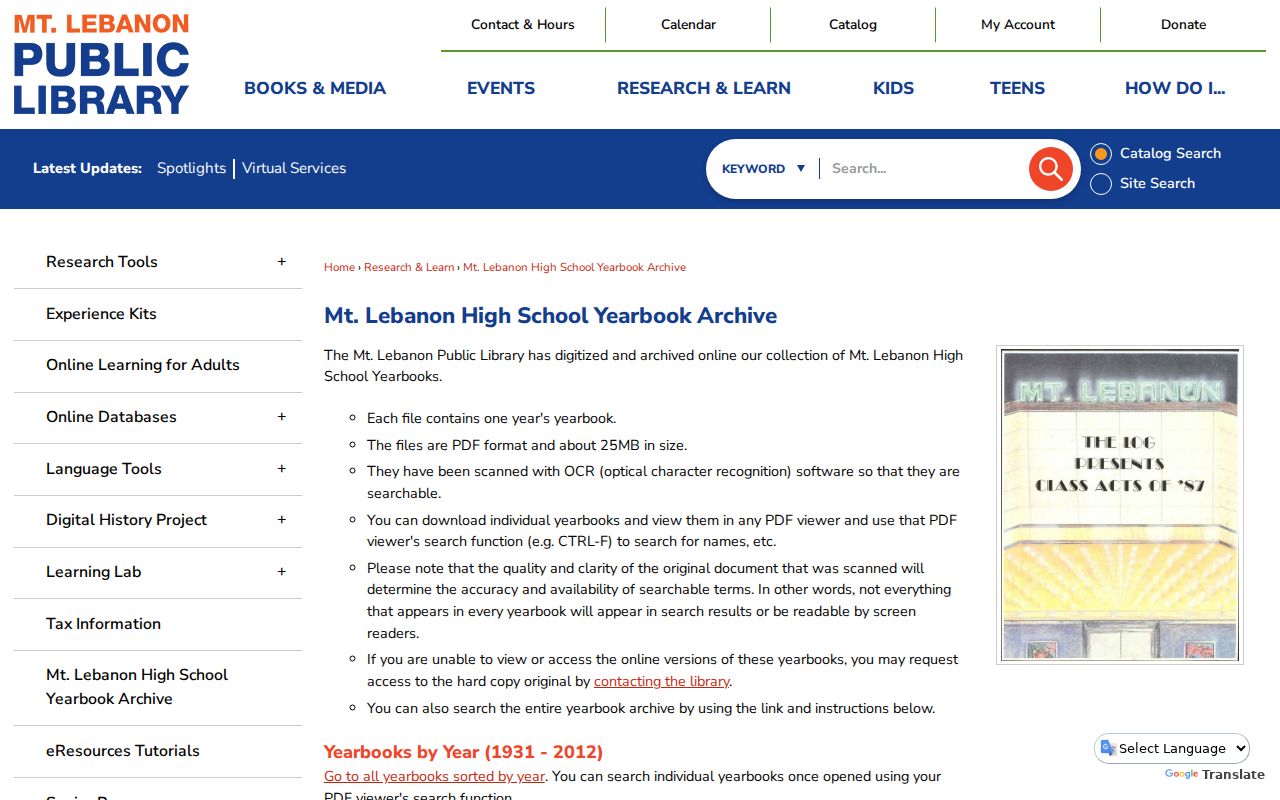
Checking the scanned page after an OCR search preserves the printed spelling and prevents a weak text recognition result from becoming a false family link.
Read Mount Lebanon Directory Entries
Read the selected volume rather than relying on a collection-level search hit. The research inspection confirmed collection metadata such as title, date, series, identifier, collection, and contributor. It did not open a particular directory page or the front-matter abbreviation key. For that reason, an entry should not be described as if it always prints a spouse, occupation, telephone, owner mark, or another status mark. Those details vary by book and must be read from the actual entry and its key.
| Exact name and initials | Copy the spelling as printed, including initials and variants, before broadening a search. |
|---|---|
| Street or locality wording | Record the address or locality exactly as the volume prints it; compare it later with a map or legal description. |
| Printed notation | Preserve an occupation, relationship, or other notation only when it appears in that selected entry. |
| Abbreviation key | Find the selected volume's own front matter before expanding a shorthand mark or letter. |
| Volume context | Keep the title, date, series, and page or image reference with the transcription. |
One entry is a lead, not a complete household list. Search the same surname in the alphabetical portion, then inspect surrounding names and the same address in adjacent years. When a fact matters for a family, estate, or historical account, preserve an image reference and corroborate it with a separate custodial record.
Mount Lebanon Directory Terms
Directory vocabulary can be deceptively compact. The selected book, not a generic rule, controls how a mark is read. A regional directory might have no street-order section at all, while a later book may include one. The terms below are useful ways to organize research, not a claim that every digitized volume contains each feature.
- Criss-cross directory
- A directory arranged by street and number rather than by surname. Use it only after confirming that the selected volume has such a section.
- Householder index
- An index that points to a household or address entry. Its scope and labels must be checked in the volume.
- Abbreviation key
- The volume's front-matter explanation for its shorthand. It is the authority for reading any printed notation.
- OCR
- Text recognized from a scan. It speeds finding a page but can misread faded or irregular printing.
Historic Pittsburgh's regional books and the library's OCR yearbooks therefore serve different roles. One can produce an address or name lead across a broad area; the other can add local school-era context. Neither should be used to infer a person's current location.
Mount Lebanon Directory Dates
The useful chronology for directory work begins before the township name becomes routine. Early land and people references may be filed under predecessor townships. Streetcar service began in 1901, the first Mount Lebanon Plan was laid out that year, Clearview followed in 1902, and the separate township began in 1912. These events help choose geographic terms, but each directory volume still has to be checked for its actual coverage.
| Date or period | Directory research implication |
|---|---|
| Before 1912 | Search St. Clair, Upper St. Clair, Scott Township, Pittsburgh, South Hills, subdivision, and church context as appropriate. |
| 1815–1945 | Historic Pittsburgh describes its regional directory collection across this period. |
| 1837–1930 | Historic Pittsburgh says digitized regional volumes are available with gaps. |
| 1931–2012 visible run | Mount Lebanon High School yearbooks add a locally specific, image-verifiable source. |
The church archive is another dated companion. The Mount Lebanon United Presbyterian Church Records guide describes unrestricted microfilm covering 1804–1997, including registers, cemetery material, session minutes, and other congregational records. It is a defined archive route, not evidence that any particular family belonged to the church.
The source guide for the church records is available through Historic Pittsburgh.
Church microfilm can supply context beside a directory year, but affiliation, residence, and family relationships still need direct support from the record being used.
Trace Mount Lebanon Directory Households
A household trail begins with one verified printed entry and then moves in both directions. Copy its name, address, and any notation the volume actually explains. Search the same person, spelling variant, or street in the prior and next available volume. The goal is to document a sequence, including gaps, rather than force a continuous story from books that may not cover the same geography each year.
- Select a volume that is likely to cover the correct Pittsburgh, South Hills, or predecessor-township geography and save its title and date.
- Transcribe the printed name, initials, address, and page reference, then read the volume's own abbreviation key.
- Check earlier and later volumes for the same name, spelling variant, street, plan, or locality label.
- Pair the dated trail with released federal census schedules, which protect personally identifiable decennial records for 72 years and currently reach 1950.
- Use maps, deeds, probate, or the local yearbook archive to test a move, a place-name change, or a same-name conflict.
A disappearance may reflect a move, death, omission, changed jurisdiction label, or the simple fact that the selected volume did not cover that area. The Mount Lebanon past residents resource applies the same careful approach to a single address, using a deed chain and maps rather than turning a directory into a complete occupancy list.
Mount Lebanon Directory Limits
Printed and scanned directories are historical research tools. They are not current resident registers, and a name absence does not prove that a person was absent from Mount Lebanon. Historic Pittsburgh warns through its coverage notes that the collection has gaps and that later volumes may need a library or archive. Library yearbook OCR also needs visual confirmation. These limits are part of the evidence, not a reason to fill the gap with a guess.
For local-context material, the Historical Society of Mount Lebanon is at 794 Washington Road and posts Thursday evening and Saturday daytime hours, with appointments accepted. Collection access is a membership benefit upon application to its collections committee chairperson. Ask whether a requested address, neighborhood, permit file, newsletter, or directory-related item exists and what access procedure applies. That is more reliable than claiming an unlisted collection is available on demand.
Note: Directory evidence is strongest when the selected volume, its geography, its page image, and a second independent record all point to the same time and place.